
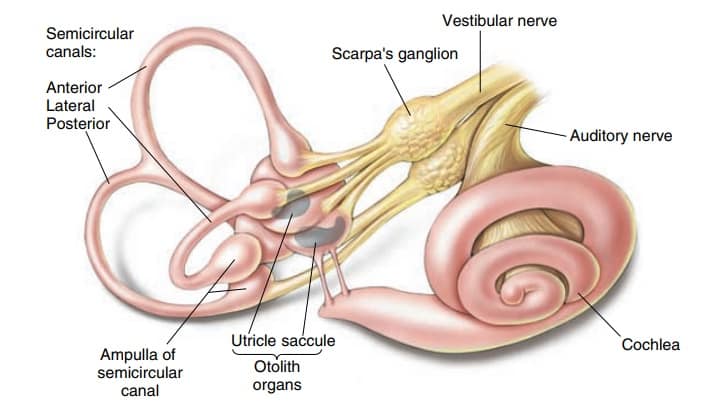
Our vestibular system works with various systems in the body and communicates with the brainstem and the brain to provide information on what is going on in our body and environment to determine what needs to be done to keep our body balanced. This communication comes from the proprioceptors in our joints, signals from our vestibular apparatus, input from the visual system, auditory system, autonomic system as well as tactile information from the skin. As I have previously discussed balance from a proprioceptive perspective at the joint level, I will discuss the information from the vestibular apparatus and its influence on postural control and eye movements as they relate to balance.
The vestibular apparatus consists of bony and membranous labyrinths and hair cells. The bony labyrinth is a space within the skull containing the cochlea (auditory system), three semicircular canals and two otolith organs. The membranous labyrinth is a thin layer of tissue suspended within the bony labyrinth. The membranous labyrinth is hollow and contains endolymph fluid. Hair cells are located within the membranous labyrinth and act as receptors. When the fluid moves the hairs, the bending motion determines the frequency of signals transmitted by the vestibular nerve.
The 3 semicircular canals are arranged at 90d from each other, following the planes of motion of the body; sagittal, coronal and transverse planes. As the head is turned, the fluid in the semicircular canal of that plane of motion lags behind and bends the hair cells. As the hair cells bend, this increases the firing of the nerve. As the head slows down or stops moving, the hair cells bend in the opposite direction causing a decrease in firing of the nerve. The left and right semicircular canals fire reciprocally; as the left fires more, the right fires less. This reciprocal firing is essential to how the vestibular system functions normally. When the signals are not reciprocal, there may be difficulties maintaining postural control, the presence of abnormal eye movements and nausea may be felt.
The otolith organs, the other 2 structures making up the vestibular apparatus, do not respond to rotation of the head, but are sensitive to the position of the head relative gravity and to linear acceleration or deceleration. Each of these otolith organs, one called the utricle and the other the saccule, contain hair cells within a gelatinous mass with a topping of otoliths, or tiny calcium carbonate crystals. As the head changes position, the weight of the otoliths displaces the gelatinous mass and bends the hair cells, stimulating or inhibiting the frequency of firing based on the direction of bend.
The vestibular nerve carries information from the hair cells in the semicircular canals and the otoloith organs to the vestibular nucleus in the brainstem and cerebellum. The appropriate outgoing response is then produced to move the body in a way to maintain an upright position and not feel dizzy. Most of the information from the semicircular canals are used to stabilize vision, keeping our eyes on the target for example, when the head turns. Most of the information from the otolith organs goes to the spinal cord influencing the lower motor neurons to postural muscles.
Balance problems in the form of dizziness, nausea or vomiting can result when the firing of the vestibular nerves are off from left to right or the vestibular nerve firing doesn’t match up to what the visual, auditory or musculoskeletal systems are communicating. This may be caused by numerous conditions, including BPPV (benign paroxysmal positional vertigo), atypical BPPV, vestibular neuritis, meniere’s disease, traumatic injury, perilymph fistula, and bilateral lesions to the vestibular nerve (often caused by antibiotic reaction).
The most common form of peripheral vestibular disorder is BPPV or benign paroxysmal positional vertigo. As its name translates, this involves a benign (not malignant) sudden symptom of vertigo induced by the changing of position. Symptoms tend to last less than 2 mins and commonly come on as a result of looking under the bed, changing positions in bed or reaching up to get something from a top shelf. The most common cause of BPPV is a condition called canalithiasis. Occasionally, the otoliths or small crystals can become dislodged and end up within the semicircular canals, disrupting the flow of endolymph and creating the sensation of dizziness. Once the movement stops, the endolymph stops movement and the dizziness stops. If symptoms persist, a procedure called the Epley maneuver can be performed to help reposition the otoliths.
Sometimes dizziness or balance problems are due to the lack of gaze stabilization. The vestibular-ocular reflex or the VOR, is a mechanism that allows the eyes to move one way while the head moves the opposite way in order to stabilize an object on our retina. When the vestibular nerve is stimulated from a head movement to the right for example, the right vestibular nerve will send the information to the brainstem. From here, a message will be sent to the appropriate cranial nerve that controls eye movement to stimulate eye movement to the left. This process lets the image stay static on the retina and not bounce around.
If balance is a problem, our muscles are going to react more to help maintain some state of balance. This may be in the form of chronic tight musculature. In fact, persistent plantar fascitis can be related to a balance issue such that the leg and foot muscles are constantly contracting to prevent falling over. Balance is an important function to test, so much so that at MMD Chiropractic, we check it on just about every new patient assessment. We only pass over this test when it is too difficult for the patient to perform, or they have a known balance issue. If you are experiencing what you think is a balance problem, please have a professional check it out further to supply you with the tools you need to improve. I would love to help you. Booking is available online by clicking the link below.