I have discussed degenerative disc and joint disease and how these 2 conditions may cause referred pain down the leg, a symptom known as sciatica. I then discussed sciatica in more detail and all the conditions that can cause sciatica. Today, I will dive a little deeper into disc injuries; their presentation, emergency situations to watch for and treatment options.
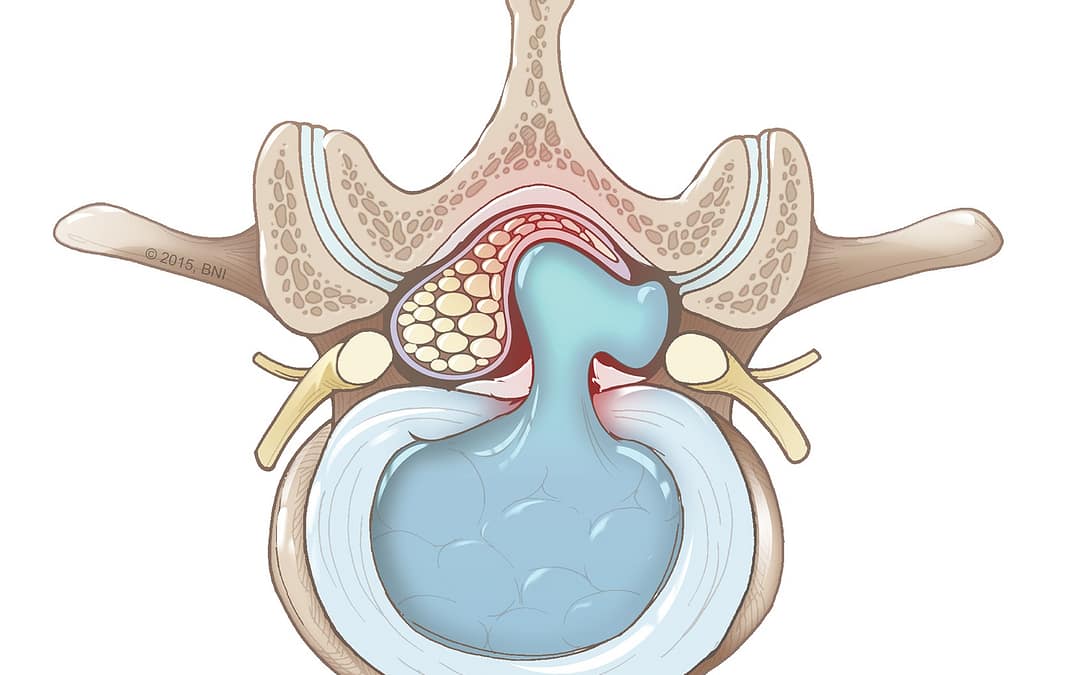
The intervertebral disc most commonly gets injured in the posterolateral aspect , the back portion of the disc to the sides, right or left. The side of leg pain is typically the side of the disc injury with the exception of a central disc which may cause bilateral leg referral, either at the same time or alternating from 1 side to the other.
- My preferred treatment protocol:
- At home: ice, nerve flossing, exercises emphasizing positions of relief
- Pain reduction- in office: laser, flexion-distraction, ART,
- Mobility and beginning strengthening- Flexion-distraction or chiropractic manipulation, ART, education on pain relieving positions and corrective exercises,
- Strengthening- Flexion-distraction/manipulation as needed, ART as needed, emphasis on core strengthening, re-education of lower extremity or upper extremity strengthening
- Performance care- on going continual care as needed to maintain mobility and continue to build on strength
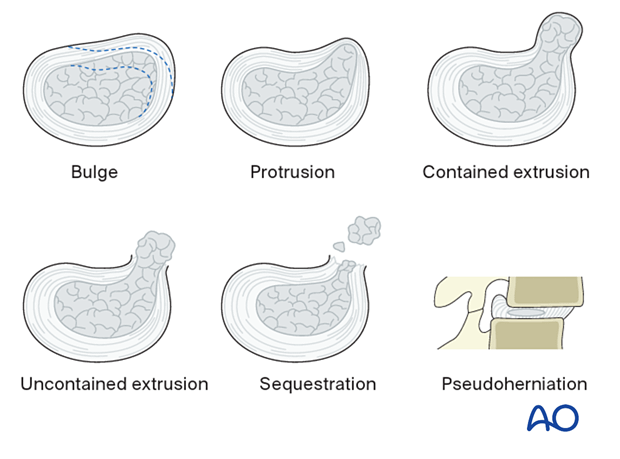
Because the outer portion of the disc is made up of concentric rings of fibrous material, an injury to the disc typically starts with small tears to these fibers. If these tears are large enough, they may reach the inner gelatinous portion of the disc, allowing it to displace and push outwards. The inner gelatinous part of the disc, called the nucleus pulposus can push against the outer annular fibers causing a bulge. With tears in the annular fibers the nucleus pulposus can herniate through to the outermost fiber and cause a bulge that pushes out further. Finally, if the outer layer of the annulus tears, the herniation can break through causing the nucleus pulposus to hang outside of the disc material. This is referred to as an extrusion.
Causes of Disc Injuries
There are multiple modes of onset for injury to a disc. However, these modes of onset can be grouped into 3 categories. For acute tears to the disc annular fibers, the prevailing factors appear to be axial compression with a rotational force. The axial compression causes a stress to the annular fibers, the rotation causes these fibers to separate from each other, both resulting in a tear to the annular fibers. An example of this would be lifting something heavy, or pushing/pulling a heavy object while turning the spine.
Disc injuries may also occur as a result of repeated motions. The force may not be high, but the repetitiveness of the motion increases stress over time resulting in a disc bulge in the opposite direction of the repeated motion. For example, a job that requires repeated flexion of the spine down and to the right, will result in a left posterolateral disc bulge.
Lastly, discs that have started to flatten out or degenerate will bulge out in all directions. Although more difficult to treat, these discs are best treated by eliminating the activities that produce pain while continuing with activities that are tolerable.
Symptoms of a disc injury
The following are symptoms of a disc injury (in the lumbar spine):
- Leg pain (often 1 leg, but can be bilateral) - including pain in the thigh, calf, front of the leg, top of the foot, toes
- Leg numbness or tingling in a specific pattern on the thigh, leg, calf or foot
- Burning in the thigh, leg, calf or foot
- Cramping or muscle spasms in the thigh, leg, calf or foot
- Increased pain or leg referral with toe touching
- Increased pain or leg referral with chin to chest motions
- Pain in the back or leg with coughing, laughing or sneezing, or bowel movements
- Numbness in the gluteal cleft *
- Loss of bowel or bladder function *
- Numbness or tingling in the genitalia *
- Leg dragging or foot drop *
* These are considered emergency symptoms and need to be addressed immediately*. If you present with any of these emergency symptoms, there is a potential risk of cauda equina syndrome occurring and if not treated, there is a risk of permanent neurological damage. To read more on whether you should go to the ER, please read here.
Does a disc injury always have leg or arm (as in the cervical spine discs) pain referrals? Not necessarily. But often, from my own clinical experience, a disc injury may show positive nerve traction tests even though there was no report of leg or arm pain. What does this mean? Maybe there is not a disc bulge present, but perhaps there are the initial small annular tears resulting in inflammation, which in itself can put some short term pressure on the nerves as they exit the spinal canal. When the nerves are then tractioned as in some in office testing procedures, a positive test may occur. If these symptoms resolve fairly quickly, there is a good chance you have sustained these small micro tears. Be aware, although your symptoms may resolve quickly, they may return again with similar activities or stress to the spine.
Treatment for disc injuries
Treatment for disc injuries really depends on the pain provoking positions and this is different with every case. With that in mind, consider the following:
- Avoid pain provoking positions
- Move within your pain-free ranges of motion
- “Motion is lotion”. I don’t know who originally coined this term, but movement for a disc injury is important. Movement helps remove inflammation, activates muscles, maintains strength (to some degree). This may mean walking up or down your stairs, stretching, biking, longer walks, etc… Laying still in bed is not recommended for acute low back pain.
- Treatment by a healthcare professional will help you with relieving pressure on the disc and nerve. This may be accomplished in many different ways depending on the healthcare provider and will vary depending on the stage of treatment you are in.
- My preferred treatment protocol:
- Pain reduction- in office: laser, flexion-distraction, ART,
- At home: ice, nerve flossing, exercises emphasizing positions of relief
- Mobility and beginning strengthening- Flexion-distraction or chiropractic manipulation, ART, education on pain relieving positions and corrective exercises,
- Strengthening- Flexion-distraction/manipulation as needed, ART as needed, emphasis on core strengthening, re-education of lower extremity or upper extremity strengthening
- Performance care- on going continual care as needed to maintain mobility and continue to build on strength
If you have experienced a recent episode of low back pain with leg pain, or know you have an existing disc injury, I want to help you. Online booking is available through our website. Consultations are available at no cost to further discuss your current health concerns and decide if this is the clinic for you. Please call to book a complimentary consultation.