
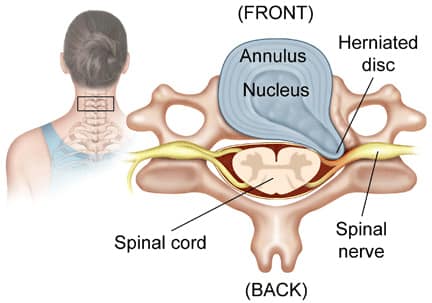
There are several structures in the neck that can be the source of pain. To review the various sources of neck pain, please refer to a prior article on Neck Pain. Here, I will strictly discuss the cervical disc as the source of neck pain, the common symptoms of a cervical disc injury as well as my approach to treatment.
As previously discussed, the intervertebral discs are located between all vertebrae in the cervical, thoracic and lumbar spine. There are exceptions at a few levels. First, there is no disc between the skull and C1 or C1 and C2. Secondly, the sacrum is made up of 5 fused vertebrae with only a disc between L5 and the sacrum. And lastly, there is also a small disc between the sacrum and the 4 fused vertebrae making up the coccyx.
The intervertebral disc is made up of an outer layer, the annulus, that is more fibrous and an inner layer, the nucleus pulposus, that is more gelatinous. The purpose of the intervertebral disc is to absorb force and allow transfer of energy. In addition, the disc helps with the extensive mobility within the spine. Injuries causing small tears within the outer fibrous structure of the disc can disrupt this function of shock absorption and be quite painful. More extensive tears in the outer fibrous layer will further disrupt the structure and allow the gelatinous center to seep into the area of damage and ultimately push out causing a bulge in the disc (outermost layer still intact) or a herniation where there is a complete tear of the outer layer of the disc.
Symptoms of a disc injury include:
- Pain in the neck, shoulder, arm or hand
- Numbness or tingling that travels down 1 arm or both arms and possibly into 1 or both hands
- Arm or hand weakness
- Loss of sensation in the neck, shoulder, arm or hand
- Pain with a cough or sneeze or bowel movement
- Muscle spasms
- Headaches
- Balance problems
Following an assessment, the healthcare provider will be able to determine a more definitive level of injury by the area of referred pain, loss of reflexes or loss of strength. In addition, the orthopedic tests that are used can help distinguish the structures injured, either the muscles, joints or the disc. We don’t truly know the extent of a disc injury until some imaging has been done. An MRI can confirm the structures involved. However, an MRI does not need to be done to treat a cervical disc injury. Often, conservative treatment is started first and imaging to follow if there is minimal to no resolution of symptoms.
Treatment options:
Modalities include ice, heat, ultrasound therapy, electric stim, laser therapy and acupuncture. Often these modalities will be used initially or at the end of treatment to try and modify pain.
Soft tissue treatment techniques like ART, trigger point therapy, massage, PIR/PNF stretching can be beneficial for the muscular tightness or spasms that may occur along the path of pain and referred pain. These may also help with improving range of motion.
Chiropractic Manipulation can be very beneficial for improving mobility when there is a disc injury. This form of chiropractic therapy may help restore motion and reduce irritation. However, due to pain levels, this may not be the first line of treatment. Whether or not manipulation is used will be greatly dependent on the patient's symptoms, level of pain and degree of immobility. The benefits of manipulation will help to restore motion even though pain may still be intense. Now exercise will be more beneficial and strength can be gained where needed.
Corrective exercise is used to both restore and maintain mobility, but also to regain and build strength. This is an important component to any injury rehabilitation. Mobility exercises don’t only move the joints and muscles, but also the nerves and vessels as they travel in and between these structures. It is important for the nerves to be able to move freely in order to prevent adhesions from forming around nerves. Extensive fibrotic tissue can inhibit nerve function, like muscular strength or sensation. With a cervical disc injury, muscular weakness can occur anywhere along the path of the nerve referral as a result of nerve compression from the disc. Muscular weakness can be permanent if the nerve compression is not reduced or removed all together. Once proper mobility has been established, strength can then be the focus.
A combination of all of these treatment options works well for most patients. Not everyone will respond the same to the same treatment. But, having some options to change treatment techniques or adding in other professionals like massage therapists, physiotherapists, family doctors and further medical specialists will only aid in providing the best care for the patient.
If you are experiencing neck pain with associated arm referral or weakness, please have your symptoms assessed by a healthcare provider that treats these issues. Booking is available online by clicking below, or you can always email drmarnie@mmdchiropractic.ca if you have any questions regarding your spine associated pain. We look forward to helping you move better and feel better!