
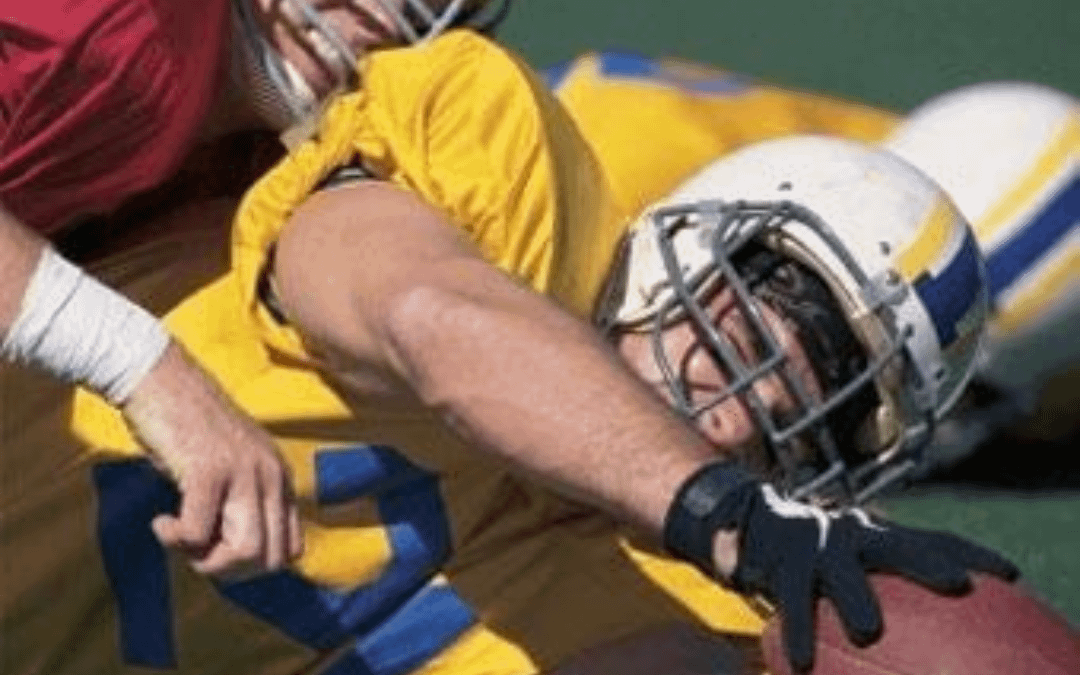
A common sports injury in contact sports or sports where there can be falls to the surface, like rugby, football, soccer, wrestling, gymnastics, etc… are nerve traction injuries, often referred to as a burner or a stinger. The common locations, nerves involved, mechanism of injury, symptoms and treatment options will be discussed further. These injuries are frequently addressed in sports injury rehabilitation, as athletes often need guided recovery to restore strength, mobility, and nerve function.
A burner/stinger injury involves the traction of a nerve beyond the nerves normal motion within the neck and upper extremity. The resulting symptom, as its name implies, can be a burning or stinging sensation in the area of the traction.
The nerve(s) commonly involved are located in the brachial plexus as it exits the neck. The brachial plexus is the group of nerves that supply motor and sensory information to the arm and hand. The brachial plexus leaves the spine and exits through the scalene muscles at the side of the neck, before they dive deep under the collar bone and travel to the arm. In a tackle or a fall, the neck can be pushed away from the shoulder under tension, causing an excessive stretch to these nerves. The resulting symptoms are often an initial burning that may be followed by prolonged numbness and tingling anywhere down the arm or hand, depending on the nerve that is tractioned the most. In addition, there may be muscular weakness which may present as just an inability to contract or, it may present as a postural abnormality. For example, the shoulder may be lower on the side of injury, or the movement of the arm or hand may be minimal.
The most common symptom with a burner/stinger is a burning sensation at the side of the neck and over the collarbone just after the injury. Some report a feeling of electric shock that shoots down the arm and into the hand. Often these symptoms last from a few seconds to minutes, but in some, the numbness may persist for several days with difficulty lifting the arm or gripping with the hand. If symptoms persist longer than a few days, a healthcare provider should be sought out to evaluate further.
As symptoms often resolve on their own, rest may be the best treatment. However, in the cases that I have seen in the office, the only symptom was a postural abnormality due to the weakness of the innervated muscles. The treatment involved some assisted range of motion, because they were unable to move on their own, followed by some isometric contractions. Isometric contractions involve contracting a muscle without moving the joint which we can often be achieve by pushing into an object. The patient is left with these exercises for homework as well as instructions to avoid the tractioning mechanism that caused the injury. This includes refraining from nerve glides or flossing exercises as these pull on the nerve at least until symptoms resolve. Cold therapy, like ice, can help calm the nerve irritation and decrease pain.
If you are your athlete are experiencing numbness or tingling into the arm following a fall, please see a healthcare professional for further evaluation. Booking at MMD Chiropractic can be done online or by calling our office at 905-529-2911. I look forward to working with you and easing your discomfort.