
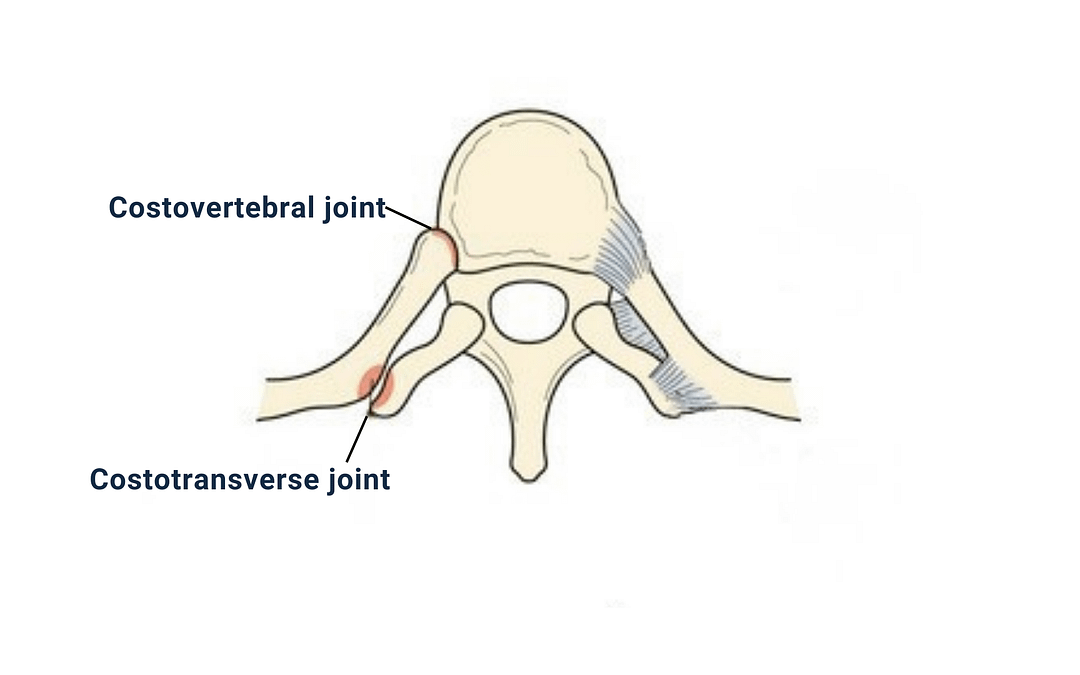
A common way patients refer to their problem is by calling it “out” or “out of alignment”. For example, rib pain is reported as “my rib is out”. Well I hate to break it to you, but this isn’t what is actually happening, so let us see if we can explain things a bit differently and help to change the understanding to hopefully change the terminology.
The rib is an interesting bone. The rib connects at the back to a thoracic vertebrae where it attaches to the vertebral body at the costovertebral joint and then also to the side piece of the vertebrae called the transverse process, at the costotransverse joint. The combined motion of these two joints allows the ribs to move through 4 different ranges; elevation, depression, and bilateral rotation.
At the front of the body, ribs 1-7 attach directly to the sternum at the sternocostal joint. These ribs move through the same 4 motions as the posterior rib joints with the vertebrae allowing for elevation, depression and then bilateral rotation. Ribs 8-10 attach indirectly to the sternum through their attachment to the costocartilage. The last 2 ribs are considered floating ribs and do not attach to the sternum.
A rib can have restricted motion at either of the 2 posterior joints or the anterior sternocostal joints. Think of all of the motions the ribs go through in one day. The ribs are the bones that move the most in the body all day long and do so whether we are awake or asleep. With 16-20 breaths per minute of every hour of every day, they are always moving. It's a wonder why more people don’t have rib joint problems.
Using the terminology of being “out” implies the bone is out of the joint. In my understanding, a bone that is out of the joint would refer to a dislocation. No doubt that this can happen to a rib joint, however, this is the wrong terminology to use for a restricted joint. You don’t want a dislocated rib. And I doubt it would be very comfortable putting a dislocated rib back into place.
Yes we can adjust a restricted rib. And we are likely getting some rib adjustments with almost every thoracic adjustment we give. Because of their close proximity to the thoracic spine facet joints, it would be hard to adjust the thoracic spine without adjusting a rib joint. Have you noticed how many pops you get with a thoracic adjustment compared to other areas of the spine? There are a lot. At each level in the thoracic spine, there are 6 posterior joints compared to 2 at both the cervical and lumbar spine. That's 3x as many. And often, we can clear out rib restrictions just by adjusting the thoracic spine.
So instead of using the term “out”, use the term restricted, not only for rib joints, but for all the other joints in the body. Unless, you can clearly see that a joint is dislocated, which then, it truly is “out”.